Matthew 28:16-20, The Solemnity of the Ascencion of our Lord
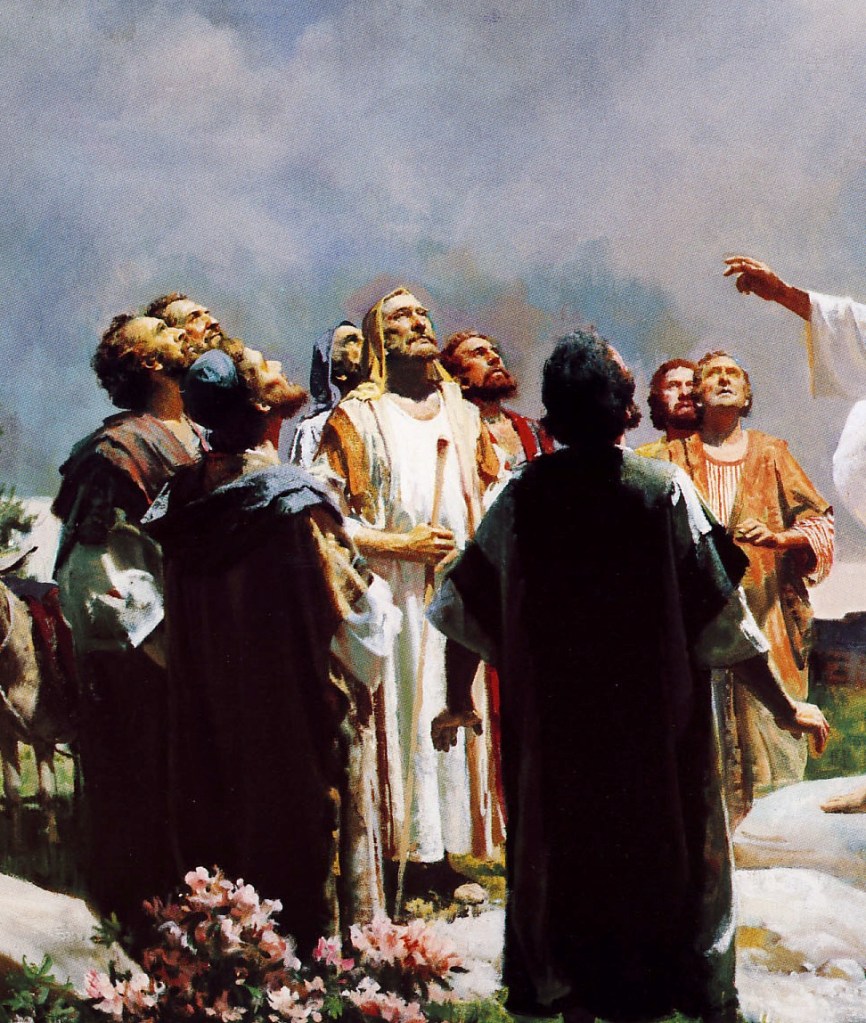
The Feast of the Ascension always feels a little strange. The disciples gather on a mountain with Jesus, and then
suddenly, before their eyes, He is taken up into heaven. One would imagine that this moment would fill them
with sadness or fear. After all, the One they left everything for is no longer physically beside them. Yet what is
remarkable is that the Ascension is not remembered by the Church as a feast of loss, but as a feast of mission,
hope, and responsibility.
And perhaps that is because the Ascension is not really about Jesus leaving the world. It is about Jesus
entrusting the world to us. Before He ascends, Jesus gives His disciples one final command: “Go and make
disciples of all nations.” In other words: “Do not remain standing there looking at the sky. Return to the world.
Continue what I began.”
That detail from the First Reading is striking. After Jesus ascends, the disciples are left staring upward, frozen
between awe and uncertainty, until the angels ask them: “Men of Galilee, why are you standing there looking at
the sky?” It is almost as if heaven itself is telling them: “Do not become spectators. Do not remain paralyzed.
The mission is now in your hands.”
Such is the question that speaks to us today. Because if we are honest, there are many reasons to stand still in
discouragement and simply stare helplessly at the state of the world. We live in exhausting times. Every day we
are bombarded with news of conflict, division, scandal, and instability. Here in our own country, many
Filipinos have grown weary and disillusioned by the chaos and noise in government, especially the spectacle
we often witness in the Senate—where public service sometimes appears overshadowed by political ambition,
personal attacks, performance, and endless controversy. Instead of helping unite the nation, public discourse
often deepens anger and cynicism.
And beyond our shores, the ongoing war in the Middle East continues to wound humanity. Every headline
represents real human suffering: children buried beneath rubble, parents mourning their dead, families
displaced from homes they may never see again. Even nations far from the battlefield feel the consequences.
The fuel crisis and rising costs of living remind us that suffering in one part of the world inevitably ripples
across the globe. Ordinary people once again carry burdens they did not create.
In a world like ours, it is easy to become overwhelmed. It is easy to grow cynical. It is easy to retreat into
silence, apathy, or hopelessness. It’s easy to stand there looking at the sky, and feel helpless. But the Ascension
refuses to let Christians live as passive spectators of history.
Jesus does not gather His disciples simply to comfort them. He sends them. He entrusts them with the mission
of transforming the world—not through domination or noise, but through witness, truth, compassion, and
fidelity. And this becomes even more meaningful as we celebrate World Communications Sunday.
Communication today is one of the greatest powers shaping human life. Words can enlighten or deceive. They
can heal or divide. They can defend truth or manipulate reality. We live in a time where people are more
connected than ever digitally, yet often more fragmented emotionally and spiritually. Information travels
instantly, but wisdom seems increasingly scarce. Outrage spreads faster than understanding. Lies often travel
farther than truth.
St. Paul, in the Second Reading, prays that “the eyes of our hearts may be enlightened.” His words ring true for
us today, because many people are informed, but not enlightened. We know many things, yet struggle to discern
what is true, what is good, what is life-giving.
And so World Communications Sunday asks us a difficult question: What kind of communicators are we
becoming? When we speak online or offline, do we bring people closer to truth, or do we bring them deeper
into hatred? Do our words build communion, or destroy it? Do we spread fear and outrage, or hope and clarity?
Do we use communication to listen, understand, and heal—or merely to win arguments and humiliate others?
The final words of Jesus in Matthew’s Gospel are not simply instructions for missionaries. They are
instructions for every Christian, they are instructions for us: “Go and make disciples.” That mission happens
not only in pulpits or classrooms, but in conversations, in posts, in comments, in family discussions, in the way
we speak about those we disagree with, and in the kind of truth we choose to defend. This is a mission that we
all have, in every aspect of our lives: personal, professional, public – but most especially public.
Because ultimately, the Church communicates not first through technology, but through witness. The Gospel
message is spread far and wide, and deeply, through the witness of our very own lives as Christians. People
may forget our arguments, but they will remember whether they encountered kindness, integrity, courage,
humility, and hope in us. They will remember whether our lives reflected Christ. For why else are we called
Christians, if our very lives do not reflect Christ himself.
And perhaps this is the deeper meaning of the Ascension: Christ now chooses to remain present in the world
through us, His people. His hands now become our hands. His voice now becomes our voice. His compassion
now depends on our willingness to love. The Lord ascends, but the mission remains grounded on earth—in our
homes, our communities, our nation, and our wounded world.
That is why the Gospel ends not with fear, but with a promise: “I am with you always, until the end of the age.”
Jesus does not promise that the world will suddenly become peaceful or easy. He does not promise the absence
of conflict, scandal, war, or uncertainty. But He promises His presence within all of it.
And that changes everything. Because Christians do not face the darkness of the world alone. We carry within
us the presence of the risen Christ—the One who has already overcome sin, hatred, violence, and even death
itself.
So perhaps the Feast of the Ascension leaves us today with one urgent question: In a world overwhelmed by
noise, confusion, conflict, and fear, what will our lives communicate?
Will we contribute to the anger? Or will we become bearers of truth?
Will we deepen division? Or become instruments of communion?
Will we surrender to cynicism? Or continue witnessing to hope?
Before Jesus ascended into heaven, He first entrusted the earth to us. May we prove ourselves worthy of that
trust.


Thank you Ninang Deb. This is so consoling. Mercy
Sent from Yahoo Mail for iPad
LikeLike