John 6:51-58, Solemnity of the Most Holy Body and Blood of Christ (Corpus Christi)
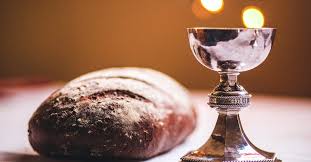
Christ is here present as bread and wine, as something so ordinary yet essential as food.
Of all the sacred signs and symbols, why this? Why not an exquisite jewel, a diamond? An ancient scroll of sacred words or a precious ring? Why not lightning? Or thunder to signify epic power?
On this feast of Corpus Christi, we discover that God is a God who is not all fury and dazzle. God is someone who comes to us as bread and wine, as someone who feeds us.
When the Lord says this bread here is my body or this wine here is my blood of the covenant, he isn’t being merely metaphorical. He isn’t saying, this bread is, well, sort of, my body. Those of us lacking in imagination would be easily bewildered as the Jews of his time who argued, “how can this man give us his flesh to eat?”
In celebrating this feast, the Lord invites us once more to be like children animated by the imagination of faith. Do you still remember your first communion? Do you remember being happy, remember Jesus being close enough to you to be inside you? Do you remember trusting those who love you, telling you that you will never be alone? Without the imagination of faith, we lose our sense of the sacred in all its simplicity and subtlety.
Bread is grown from seed buried in the earth. It comes from the toil of many hands, from grain that is taken, bound, ground, pressed, kneaded, and brought to the fire. And wine is taken from grapes that are bound, pressed, crushed, bruised, and made to season in patience and over time.
The image reminds us of toil, of what is sown and gathered and thrown, the fire and stillness and waiting that we go through to find nourishment. We are fed by bread and wine, by body and blood, by love and sacrifice, the oblation of Christ our Lord.
The image of bread and wine mirrors that of a bound, pressed, crushed, and broken body, striped in blood draining to the ground. It is a powerful, if disturbing image. Mysteriously, this is who God is. Graciously, this is how God remains with us when he saves us.
The risk is real of missing what the Eucharist is all about and why we come to mass Sunday after Sunday. At root, the Eucharist is a passover meal taken by a people in flight, a meal of deliverance, food for the journey. We receive communion not because we have been good or that all is well with our lives. We receive communion because this journey through the wilderness of our world often leaves us hungry and anxious and disconnected.
Only with the imagination of faith will we realize again that when the body of Christ was broken and emptied of his blood on the cross, God was not running away from the messiness of our lives. God was taking in, taking all this upon himself. All the crumbs and stains, all the lostness and longing of our lives, now taken up into his body and blood.
And so it is, that by the stain of his blood on wooden hearts like ours, death and despair passed us over. By his stripes, the wounds on his body, we are healed.
The song, “Now We Remain”, proclaims:
We are the presence of God, this is our call,
Now to become bread and wine,
Food for the hungry, life for the weary.
To become the presence of God, this is who we are meant to be. To let God transform us into sacraments of his love in this time of war and hunger and hopelessness, this is our way out of the wilderness.
Sunday after Sunday we come to the Eucharist to remember him whose blood in our veins brings true life. We draw close to his table of sacrifice in memory of him whose body in our bodies gives us true strength.
Those who lack poetic imagination will probably shrug this off. Those without the faith of a little child will walk away bewildered, yet hungry still.

