Matthew 4:1-11; First Sunday of Lent
Much of Manila has changed since I left more than a decade ago. Along Katipunan there are far more high rise buildings. The site where a former school used to stand is now a sosyal (fancy) shopping mall. We also have the second largest parking lot in Manila, otherwise known as Katipunan Avenue.
Some spaces have not changed at all. There are still many green spaces in the Ateneo and UP campuses.The fathers recreation room at Loyola House of Studies still looks pretty much the same. And, if you look into the refrigerator, you will still find a milk carton with a few drops of milk in it, which I think is the characteristic sign of a Jesuit community.
The changing of spaces around this city shows our changing circumstances, needs, and priorities. Our readings today articulate the changing circumstances of humanity and God’s response to our needs through the metaphor of the changing of spaces.
Our first reading is set in the lush garden of Eden, the site where God created Adam and Eve. In the inspired imagination of the author of this text, God is like a gardener who creates everything out of this ground — trees, animals, and even humans — highlighting an intrinsic unity of all things to the soil. There is something especially tender in the manner in which God creates the human person. God not only fashions them, God shares with Adam his breath. But, in spite of the abundance of the garden, the first humans are not content with what God had created. Although they share God’s very breath, Adam and Eve are still tempted to become gods. Although set in abundance, they want more. And, their acquisitiveness reveals not divinity but their naked fragility.
As if to trace how much the spaces we inhabit can change because of our naked acquisitiveness, the Gospel places the story of the temptation of Christ in a desert. This story not only traces how far we can turn away from paradise, it also shows us how far God will go to redeem us. In the desert, Jesus shows us how much we are capable in a space of scarcity. In each of his temptations, Jesus refuses to use power for his own benefit. In doing so, Jesus teaches us that our true humanity lies not so much in what we have or the power we wield, but in naked trust that God will provide. Jesus’ humility ends his temptations and reveals angels looking after him.
But, our readings today not only intimate to us the importance of the transformation of external spaces. Far more crucially, our readings invite us to consider the transformation of the interior space of our hearts. As our needs and priorities change, our hearts too can change from gardens into deserts. Our psalm intimates as much: A pure heart create for me, O God, put a steadfast spirit within me. Our hearts may have turned from lush gardens to a lifeless desert, and the psalmist prays to be returned to that first moment when God created Adam and breathed God’s spirit into him.
Lent is this privileged time of grace when we enter the desert with Christ. By learning to let go of what we want, we ask Jesus to teach us what we really need. In this sense, although the desert can be a symbol for the world that we ravish through our naked acquisitiveness, it can also be a symbol for the space where we learn of God’s providence. Through Jesus’s story, we learn that God’s providence extends even to the most barren deserts of human experience, even to death on the cross at Golgotha.
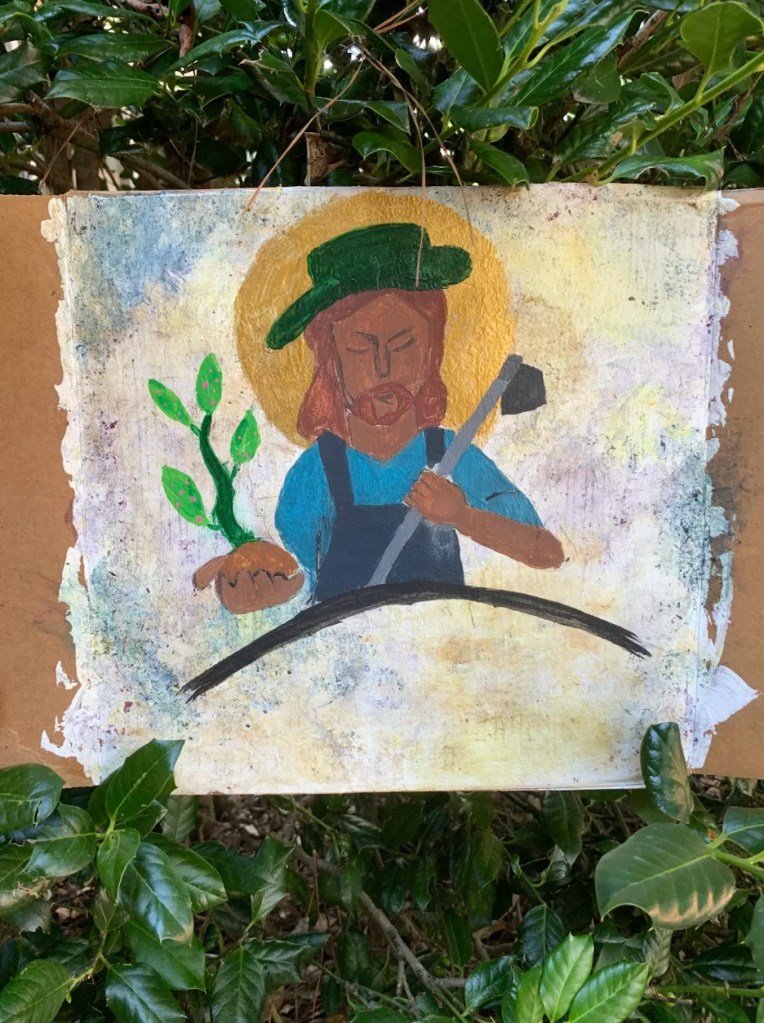
But, the story of Lent does not end in the barrenness of Golgotha. Indeed, the Christian story begins again on Easter morning when we are brought back to a garden in which Jesus is mistaken for a gardener, thus, recalling the manner in which God creates all life in the book of Genesis. Jesus comforts the sorrowful Mary Magdalene on Easter morning, turning her heart away from despair by sowing seeds of hope in her heart.
Will I allow the divine gardener to enter the deserts in our world and in my heart and transform it into a garden?
Image by: Rev. Bethany Apelquist
 One Lost Sheep