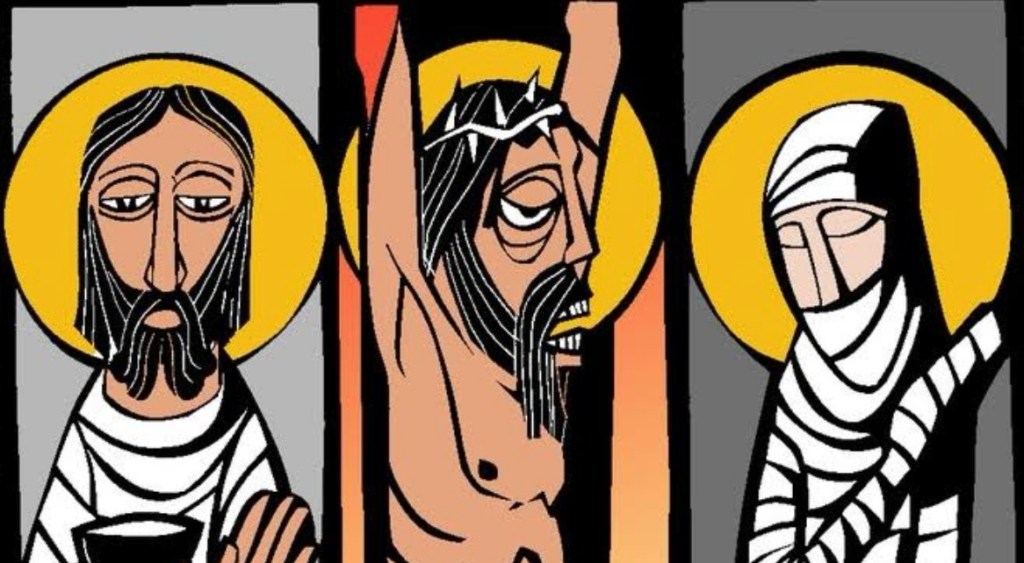
Please consider using this excellent guided reflection prepared by Fr Weng Bava SJ for each day of the Paschal Triduum. This is for personal and group mediation on the Passion, Death and Resurrection of Our Lord through the mundane and often unnoticed tiny details in Gospel narratives.
A Reader-Friendly Prayer and Reflection Guide
Introduction
The Paschal Triduum—from Holy Thursday to Easter Sunday—is the holiest time in the
Christian calendar. These days are dense with symbolism, liturgy, and meaning. Yet often, the smallest elements in the Gospel narratives go unnoticed: a donkey, a basin, a fire, a rooster. Each one is charged with divine presence. This guide invites you to slow down and pray through these seemingly mundane things that bear witness to the Passion, Death, and Resurrection of Christ.
This is not a theological textbook or a long devotional. It is a gentle companion in your quiet hours. Let each item become a doorway into mystery. Let each moment open your heart to grace.
How to Use This Guide
1. Set aside quiet time each day from Holy Thursday to Easter Sunday.
2. Begin with the opening prayer provided.
3. Slowly read the list of items for the day.
4. Spend time with the Scripture passages connected to them.
5. Reflect using the “Things to Notice” and “Questions for Further Reflection”.
6. Close with the day’s ending prayer.
You may journal your thoughts or simply rest in silence. What matters is not how much you read, but how deeply you listen.
Holy Thursday – Objects of Intimacy and Betrayal
1. The Donkey (Luke 19:30)
Meditation:
Consider the donkey. Of all the majestic animals that Christ could have chosen to enter the city, why a lowly, common donkey? It’s not an animal typically associated with royalty or power. Yet, Christ chooses this humble creature, and even more, a donkey no one had ever sat upon before. This ordinary animal becomes the bearer of the King of Kings. It is silent, steady, and carries Christ in a way no other creature could. The donkey represents the peace Christ brings—a peace that often goes unnoticed and unappreciated, but is powerful nonetheless.
Reflection:
In my life, where am I choosing the “majestic” over the humble? How do I recognize the quiet ways in which God chooses to enter my life, through simple and unnoticed things? Do I appreciate the stillness in the service God calls me to?
2. The Basin and Towel (John 13:5)
Meditation:
Imagine the basin of water and the towel. These are simple, everyday objects, yet they become instruments of profound love. The basin is used not just for washing feet but to reveal the heart of Christ’s service. The towel, though a common item for drying hands, becomes a symbol of humility, an instrument that cleanses not only dirt but also pride. The Lord of the universe uses these objects to remind us that love and leadership are found in humble service. A basin, a towel—items often taken for granted—become the tools by which we understand Christ’s sacrificial love.
Reflection:
Do I ever see myself as “too important” for humble service? How can I serve others today in ways that mirror Christ’s humility? In what ways do I need to let go of my pride and embrace the quiet acts of service that reflect Christ’s love?
3. The Bread and the Cup (Mark 14:22-24)
Meditation:
Think about the bread and the cup. These ordinary items, typically part of a shared meal, are transformed in a single moment into the Body and Blood of Christ. Bread, which nourishes our bodies daily, is now the source of eternal nourishment. The cup, once filled with wine to mark a festival, becomes the vessel of salvation. Jesus takes these common items and infuses them withvdivine meaning. In this simple meal, He gives us Himself—His body, His blood—as food for the journey.
Reflection:
Do I approach the Eucharist with reverence, recognizing the extraordinary grace in the simplicity of the bread and wine? How do I allow Christ to nourish my soul, as the bread nourishes my body? What does it mean to partake of Christ’s body and blood in the Eucharist?
4. The Kiss of Judas (Luke 22:47-48)
Meditation:
A kiss—a symbol of affection and intimacy—is turned into the ultimate act of betrayal. Judas,who had walked alongside Christ, uses this familiar, tender gesture to hand Him over to His enemies. The kiss, once a sign of love, is now a tool of deception. This simple act, so ordinary in its appearance, carries the weight of betrayal. It reminds us that even the most intimate gestures can be corrupted when they are turned against the ones we love.
Reflection:
Have I ever used words or gestures meant to show affection, but instead turned them into betrayal or hurt? Where in my life do I need to restore honesty to my actions, especially in my relationships? How can I ensure that my love is always true and not twisted for selfish reasons?
5. The Ear of Malchus (Luke 22:51)
Meditation:
In the chaos of Christ’s arrest, Peter strikes Malchus’ ear. The act of violence is swift, but it is not the final word. Jesus, in His final act of mercy before His Passion, heals the ear. A simple, yet profound, act. This act of healing, done in the midst of betrayal and injustice, shows Christ’s commitment to peace and mercy. The ear, a small but vital part of the body, represents the last physical act of healing before the cross—teaching us that even in the midst of violence, Christ brings peace.
Reflection:
How do I respond in moments of conflict or when I am wronged? Can I, like Christ, bring healing where there is violence? In my own life, where do I need Christ’s healing touch to restore relationships or peace?
Closing Prayer for Holy Thursday
Lord Jesus,
You washed the feet of Your disciples, showing us that love is not just spoken but shown in humility and service. Help me to embrace the humble, quiet acts of love that You used to transform the world. As I reflect on these simple objects, may I see Your presence in the ordinary things of my life.
Teach me to serve as You served, love as You loved, and follow You in humility.
Amen.
Good Friday – Objects of Violence and Recognition
1. The Thirty Silver Coins (Matthew 26:15)
Meditation:
Consider the coins—small, cold, metallic pieces. In themselves, they are just currency. But in Judas’ hands, they become the price of betrayal, the weight of a friend’s soul. They clink and chime with a chilling indifference, as if to mock the gravity of what they have purchased. Money, so often seen as neutral or necessary, here becomes the agent of deepest treachery. They
are later cast onto the temple floor, rejected and too tainted for sacred use. Their silence echoes loudly through the centuries: “What is the price of your loyalty?”
Reflection:
What in my life is worth more than Christ—and what have I been willing to trade Him for? When have I chosen convenience, comfort, or control over fidelity? How do I use or misuse the resources entrusted to me?
2. The Rooster (Luke 22:60–61)
Meditation:
The rooster crows—a natural, almost annoying sound at dawn. But for Peter, it is a dagger. It interrupts his third denial with brutal precision. A creature doing what it was made to do ends up bearing witness to human failure. There is no cruelty in the rooster, no awareness of what it announces—just the raw sting of truth. Its call is not judgment, but memory, summoning Peter to recall the words of the One he loves. Sometimes, grace comes through the ordinary sounds we wish we could silence.
Reflection:
What are the “roosters” in my life—those uncomfortable moments or reminders that awaken me to my failures? How do I respond when confronted with my weaknesses? Can I believe, like Peter, that even failure can become a path back to grace?
3. The Fire in the Courtyard (John 18:18)
Meditation:
Picture the fire in the courtyard. Its flames offer warmth in the cold night air. Peter huddles near it, trying to blend in, trying not to be noticed. The fire casts flickering shadows, revealing and concealing, warming and warning. Around this simple fire, truth is denied, identity is hidden, and fear simmers. It becomes a stage for human frailty. Yet even in that place of denial, Christ’s gaze finds Peter—not to condemn, but to begin healing.
Reflection:
Where are the courtyards of my life, the places where I hide or stay silent out of fear? What are the fires I warm myself by when I should be standing closer to Christ? Can I let Christ look at me even in my weakest moments?
4. The Seamless Tunic (John 19:23–24)
Meditation:
Christ’s tunic is a single piece, woven without seam—whole, unbroken. The soldiers see its value and cast lots for it. It is not torn, even in death, suggesting a quiet dignity even in cruelty. A garment becomes a relic, a testimony to the person who wore it. It’s as if the wholeness of this piece of cloth points to a mystery: though His body is broken, His person remains undivided. They divide His outer garments, but not this—the inward garment remains whole.
Reflection:
In what ways is my life “seamless” or fragmented? Do I preserve wholeness of character even when others tear me down? How do I treat others’ dignity—do I gamble with it or guard it?
5. The Nails and the Hammer (John 20:25, implied in crucifixion narratives)
Meditation:
We never hear the sound of the hammer in the Gospel—but we feel it. Each strike drives the nail deeper into flesh and wood. Tools of carpentry, once used to build, are now instruments of execution. How strange that Christ, the carpenter’s son, is fastened by the very tools He would have once handled with love. The nails are rough, functional, brutal—made to hold, not to heal. And yet, in being driven through Him, they become part of the salvation of the world. Violence doesn’t get the last word—love does.
Reflection:
What in my life has been twisted from good into harm? Do I allow Christ to transform the instruments of my pain into channels of grace? Can I believe that what pins me down might also be part of what raises me up?
Closing Prayer for Good Friday
Lord Jesus,
You were sold for silver, denied near a fire, stripped of Your garment, and fastened by nails.
You took all that is base, cold, and cruel, and You turned it into an offering of love.
Teach me to find You in the broken places, in the clinking coins and crowing roosters of my life.
Help me not to look away from the suffering You embraced.
Let the memory of these simple things call me to a deeper love.
Amen.
Holy Saturday – Objects of Silence, Grief, and Waiting
1. The Tomb (Matthew 27:60)
Meditation:
It is borrowed, unused, hewn from rock—a quiet place for the dead. Joseph of Arimathea offers it, expecting finality, not resurrection. The tomb is cold, dark, and still; a place that speaks of endings, not beginnings. Yet it becomes the womb of new life, a sacred threshold between death and resurrection. For now, though, it is heavy with absence. This is where love lies buried. This is where hope appears dead—but isn’t.
Reflection:
Where in my life do I feel like all is lost? What “tombs” do I linger near—hoping, doubting, waiting? Can I dare to believe that God’s silence is not His absence?
2. The Large Stone (Matthew 27:66)
Meditation:
They rolled it into place. Heavy, final, and sealed. It was meant to ensure no one could enter—and no one could leave. The guards stood by it, not knowing they were guarding the greatest surprise in history. The stone represents human attempts to control death, truth, and God Himself. But it cannot hold Him. What men rolled in certainty, God would roll away in triumph.
Reflection:
What stones have I placed in my heart—walls to keep God out or protect myself from grief? What truths do I try to seal away, afraid of what they might uncover? Do I trust that God can move even the heaviest obstacles?
3. The Linen Cloths (Luke 23:53)
Meditation:
Simple strips of fabric, used to wrap the body of Jesus. They speak of tenderness, of final acts of care and reverence. No incense, no hymns, no crowd—just cloth and silence. These linens cradle what looks like failure, but in God’s timing, they will be left behind like butterfly shells. Their stillness holds a promise: that what was wrapped in death will soon burst into life. These are the quiet signs of devotion and love, even in the shadow of loss.
Reflection:
How do I handle what seems dead or beyond hope? Can I continue loving and honoring even when I don’t understand? What does it mean to wrap something in love and let go?
4. The Tree Where Judas Hanged Himself (Matthew 27:5)
Meditation:
It is not often mentioned on Holy Saturday, but it looms in the background: the tree of despair.vWhile Christ is descending into death to rescue the lost, Judas succumbs to shame, alone. This tree bore the weight not of sin itself, but of unbearable guilt. It is the shadow side of Calvary—a place where mercy was refused, not because it wasn’t offered, but because it wasn’t believed. And yet even this tree is not beyond God’s gaze. Christ died for Judas too.
Reflection:
What do I do with my guilt? Do I believe in God’s mercy even when I’ve failed miserably? Can I pray even for those who died in despair?
5. The House of Mary, Mother of Jesus (Implied, John 19:27)
Meditation:
John took her into his home, and there she stayed. Imagine the silence. The absence of Jesus in the house where once there was laughter, presence, touch. Mary’s house becomes the firstvsanctuary of the Church on Holy Saturday—a place of sorrowful faith. She waits, not with answers, but with memory. Her grief doesn’t cancel her hope. Her stillness is not emptiness—it is reverence.
Reflection:
How do I wait with sorrow and hope together? Do I let others into my home and heart when I’m grieving? Can I be still without needing clarity or closure?
Closing Prayer for Holy Saturday
Lord of Silence,
You rested in the tomb, and all creation held its breath.
Teach me to wait with faith, even when You seem far.
Help me honor the mystery of grief without rushing to resolution.
Let my silence become a sanctuary for You.
And may I, like Mary, keep believing through the darkness
Until the light returns.
Amen.
Easter Sunday – Objects of Surprise, Memory, and Renewal
1.The Rolled-Away Stone (Luke 24:2)
Meditation:
It’s the first detail the women see. They come expecting to anoint the dead, but the stone—this massive, immovable object—has been rolled away. No human could’ve done it unnoticed. It’s not just a logistical detail; it’s the first hint that nothing is going to be the same. The stone, once meant to seal death, now lies off to the side, irrelevant. It is God’s exclamation point in the grammar of resurrection. What they expected to block their way has already been handled.
Reflection:
What stones do I expect to find in my path? How often do I presume death or despair will remain in place? Can I recognize the signs that God has already gone ahead of me?
2. The Empty Linen Cloths and Folded Headcloth (John 20:6–7)
Meditation:
Peter and John find something odd: the burial linens are left behind. And not in disarray. The headcloth is folded, set aside—as if someone had risen calmly, with purpose, not fled in haste. These are the details of resurrection that only the eyes of love would notice. It is as if Jesus wanted to leave a signature of peace. The empty linens say: “I am not stolen. I am risen.”
Reflection:
Do I notice small signs of life and renewal in the ordinary? What have I discarded too quickly as empty, without realizing it holds a message? Can I believe that resurrection doesn’t always shout—it sometimes folds cloths?
3. The Unused Spices Prepared by the Women (Luke 24:1; Mark 16:1)
Meditation:
They brought the spices. This was love’s last gesture: to anoint the body. They rose early, performed the rituals, carried grief on their shoulders. But the body they came to honor was gone. The spices go unused, their purpose outpaced by a miracle. It’s a tender kind of disorientation—when love prepares for mourning but is met with joy instead. Their care wasn’t wasted—it was transfigured.
Reflection:
How do I respond when my plans of love are interrupted by God’s greater purposes? Have I ever seen my sorrow overtaken by grace? Can I trust that even unused efforts can become offerings?
4. The Voice Mistaken for the Gardener (John 20:15–16)
Meditation:
Mary stands weeping. She sees someone but doesn’t recognize Him. She thinks He’s the gardener—because who else would be here at dawn? Yet when He speaks her name—“Mary”—everything changes. In that moment, a voice she knew from the beginning reawakens her. She doesn’t need a sermon. She doesn’t even need proof. Just her name, spoken with love, in the mouth of the Risen One.
Reflection:
Do I believe Jesus speaks my name in love? Am I able to recognize Him in the ordinary voices, mistaken identities, and early mornings of life? What happens in me when I’m truly seen?
5. The Long Walk to Emmaus (Luke 24:13–35)
Meditation:
Two disciples, disillusioned and done, walk away from Jerusalem. Their hopes are buried. A stranger joins them, asks questions, listens. Along the way, He explains Scripture, but they still don’t see—it isn’t until the breaking of bread that their eyes are opened. The road, the talking,bthe ordinary act of walking home: these become sacramental. The mundane reveals the Messiah.
Reflection:
When have I walked away, only to find God walking beside me? Do I believe the risen Christ still comes as a stranger, a conversation partner, a guest at my table? Am I open to resurrection even when it takes the shape of a journey?
Closing Prayer for Easter Sunday
Risen Lord,
You came quietly into a garden and called us by name.
You left behind cloths, stones, and spices as signs for those who seek You.
May I never mistake the silence for absence, or the ordinary for emptiness.
Let me walk with You, even when I don’t yet recognize Your face.
Let my heart burn within me.
And may I, like Mary, run to tell the others:
He is alive.
Amen.
(For personal and group use only)
 One Lost Sheep
Thank you, i will be sharing Fr Weng’s reflection!Monet D ShaughnessySent from my iPhone
LikeLike