Mark 10:35-45; 29th Sunday in Ordindary Time
When our good friends are on their way to the top, we often say, “Huwag mo kaming kalimutan ha?” (“Don’t forget us, ok?”) We do that in jest and affection. “Huwag mo kaming kalimutan” is really our way of saying, “Congratulations! Happy for you! Good luck!” James and John’s pitch to Jesus didn’t sound like that. “In your glory, grant (meaning: give it) that we sit beside you.” That wasn’t about Jesus’ glory. That was using Jesus as a “connection” to assure theirs. James and John still didn’t get it: palakasan, ambisyon, power had no place in Jesus’ modus operandi and modus vivendi. He was, in fact, counter-witnessing to precisely that kind of Temple drug that the hierarchs were high from sniffing. James and John needed a seminar on the difference between ministry and exploit.
I’m sure you’ve seen this happen, sisters and brothers. Sometimes, what starts out as a mission, a voluntary ministry, an apostolate—mutates into an exploit. Among priests, for example; we start out as ministers of the Word. Then, we become popular. This makes some tipsy, some drunk. Then, we start thinking, behaving, and wanting to be treated…like celebrity, pandering now for more and more likes, follows, and subscribes, literally and figuratively. What before was ministry is now an exploit. Same with many politicians. They start out w/ the sincerest intentions to uplift the poor and our nation. But then, they learn the life hack to uplift themselves and fatten their bank accounts. Social responsibility before, exploit now. In church life, same thing. Volunteers hear God’s call to help a parish, chaplaincy, outreach, in some behind-the-camera way, so to speak. Then, they become possessive and protective of their roles, compete with others or put them down, and presume they’re indispensable. What started out as an apostolate, is now an exploit. Still happening today is what was beginning to happen to James and John: ministry deteriorating into exploit.
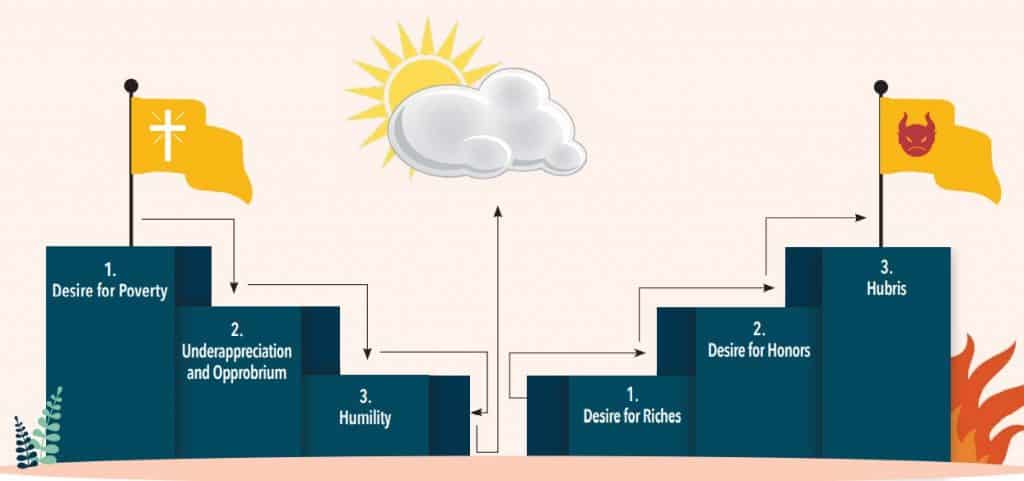
St. Ignatius has a handy phrase for this which he calls the Two Standards: the Standard of Christ and the Standard of Satan. Christ’s Standard consists in poverty, humiliation, and humility. Meaning, in serving the Lord, we must be ready to assume spiritual and/or material poverty. We might just be humiliated for this because the world does not understand why we’re doing this to ourselves. But keeping at it, it results in humility. We hear this Standard when Jesus says: “Can you drink of the cup I am to drink (the cup of suffering) and be baptized with the baptism I am baptized (the baptism unto death)?” Poverty, humiliation, humility: Standard of Christ. Ministry.
Riches, honor, and pride: the Standard of Satan. Opposite. While we’re doing ministry, the devil sneaks in. It lures us to the material or often, psychological pleasures of ministry, gratifying our egos! Then, we seek more honor, usually by “reflected glory.” “Close kami ni Lord,” like James and John presumed. Or, today, “Close kami ni” whoever represents the Lord (bishop, priest, chaplain). It then results in the capital sin of pride. Standard of Satan: riches (material, psychological), honor, pride. Exploit.
So, the difference between Ignatius’ Two Standards marks the difference between ministry and exploit. Ministry is all about God’s people, for which we become selfless, naglilingkod sa kapwa. Exploit is all about us, for which we become self-promoting, presumptuous, and smug. But like any demonic deception, exploit dresses itself up in the shining armor of “service.” Kaya ang exploiter, nagmamaniobra rin ng kapwa, in the guise of paglilingkod.
Our security guards shared with me something funny: minsan daw, may mga abusadong driver. Kapag sinita, kasi walang gate pass, o kamote mag-parking, galit pa raw at nagbabanta pa. Tawag daw nila sa mga ganong driver, “Fil-am”; feeling amo (“boss”). Well, Jesus was very quick to disabuse James and John of their “Fil-am”, their delusions of grandeur. Hindi niya sila pinatagal at pinamihasa sa maling akala. “To sit beside me is not mine to give. I’m not the amo. I have no say-so on who gets to share and reflect the glory. But whoever wishes to be great among you will be your servant; to be first, he must be slave of all. I did not come to be served like an amo, but to serve and give my life as ransom for many.”
Are we involved in some ministry, sisters and brothers? How do we check ourselves if we’re still under the Standard of Christ: poverty, humiliation, humility? What signs do we watch out for in case it’s beginning to become an exploit: riches, honor, pride? If we’re in charge of ministries, how do we catch someone who’s already “Fil-am”? Catch, meaning, hulihin, yes. But more so, catch, salô, meaning, save. Because when someone goes from the Standard of Christ to the Standard of Satan, one really falls and not even know it. Kailangan hulihin at saluin.
The best thing about the status of servant under Jesus as our Amo, is that our Amo is merciful and trustworthy, as today’s psalm says. Mabait ang Amo natin. Even now, when he’s in the highest glory, if we ever ask him, “Lord, ‘wag mo kaming kalimutan ha?”, he’s sure to answer, “Basta ikaw. Nanginginig pa.”
*Image from the website of the Jesuit Central and Southern Province
 One Lost Sheep