John 20:19-23, Pentecost Sunday
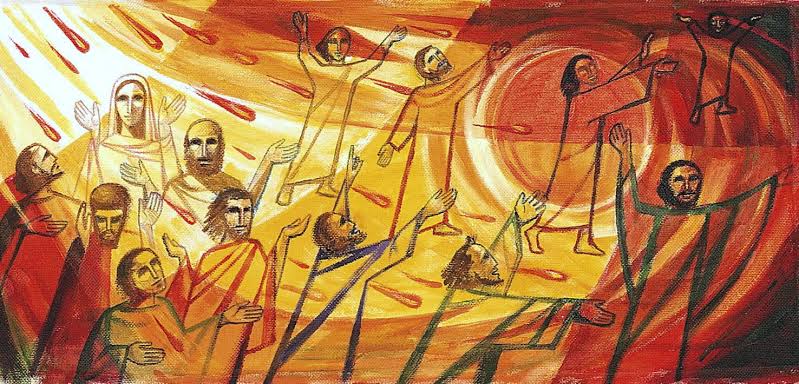
The New Testament Greek word for soul or spirit is pneuma. But that’s only the translation of the Old Testament Hebrew, ruah, breath or air or wind. Hence, when used of God, ruah & pneuma and mean breath of life, or an atmosphere or ethos of sacredness, or the unstoppable force of nature. God is all of these. Another word associated with God is fire; like the burning bush that called Moses, the pillar of fire that showed the Hebrews’ way through the desert, the fire that refines and purifies us like it does gold; and today, tongues of fire that enlighten and embolden. God is all of these.
If we think about literal breath and fire, sisters and brothers, notice how they can be contained only so far, whereupon they eventually break free. We can hold our breath for only so long, for example. But it will eventually push itself out of our chests whether we like it or not. We can confine fire only so much. But its heat will steadily break whatever it touches down to its weakest, most fundamental elements, until fire escapes from captivity.
The Holy Spirit did the same thing to Jesus’ friends, did you notice? The Spirit broke the Apostles free. As they breathlessly hid away from their hunters, the Spirit blew through and into them the breath of life. Nabuhayan sila ng loob. From closeting themselves in darkness, the Spirit emboldened them to put themselves in the full light of day to even dare say, “Listen, Israel – Jesus, whom you killed, is Lord and Messiah.” Matapang na sila at pangahas pa! The Spirit loosened their fear-stiffened tongues to speak in various languages that even pagans and Gentiles found compelling! Most of all, the Spirit steeled their resolve to be tortured and killed rather than suppress their faith in the risen Messiah. Not bad for a ragtag bunch of nobodies and cowards who left Jesus for dead. I bet even the Apostles themselves never thought they had it in them. Well, they really didn’t. Only the Holy Spirit could inspire such nerve. Only the Holy Spirit could stoke such passion.
That’s what I love about the Holy Spirit of the Father and the Son, dear sisters and brothers: irrepressibility. No human institutionalization can ever curb the breath and fire that the Holy Spirit is. No hierarchy can ever stifle him. No men’s club, no matter how strictly guarded and preserved, can ever privatize the Holy Spirit’s power. Look how far our Church has gone from 20, 50, a hundred years ago, not just our liturgy, but everything that we believe and appreciate about our faith. Our community is ever ancient, yes. But look at how it’s also ever new and ever today. The Spirit of Father and Son has blown past our tired fundamentalisms that say, “In our Church, don’t question. Just obey.” The Spirit has undercut our patronizing sexisms that mutter: “In our Church, males have the upper hand because Eve was only subsequently created from Adam’s rib.” (By the way, following that logic: Adam was created from dirt, wasn’t he? So, men must be inferior to dirt!) The Holy Spirit has deflated our 18th-century-style clericalism that boasts: “Priests are God’s gift to the people (instead of, really, the other way around; the people are God’s gift to priest).” The Holy Spirit has even proven to us by numbers that God is animating and sustaining churches and faiths other than our own. So, like breath, Spirit blows where Spirit wills. Like fire, he ignites what he touches, regardless of religion (not just Catholicism), regardless of language (not just Latin), culture (not just western), or even liturgy (not just the Roman rite). The Holy Spirit will always reach for more people, breathe more communities into life, and inflame more hearts and souls than we can imagine.
This should be good news to us, dear sisters and brothers. This is the true Spirit of what it means to be Catholic: universal, whole, inclusive, which are divine characteristics. Accordingly, divine movement in individuals and communities is always forwards, never backwards; opens up rather than shuts down; broadens rather than constricts. Kapag makitid mag-isip, dumama, o makipagkapwa ang isang tao, o pamilya, o komunidad, o parokya, malamang hindi na nangingibabaw ang Espiritu ng Diyos, kundi damot at kapricho ng tao. Otherwise, the Spirit of Father and Son will always include not exclude; build not demolish; invite by inspiring, not coerce by terrorizing. In other words, the Holy Spirit is irrepressibly free and irrepressibly loving. Hindi siya makitid. Hindi siya nagpapabihag. Hindi nagpapasolo. Walang may-ari ng Espiritu-Santo dahil walang nagma-may-ari sa Diyos.
Kaya bantayan po natin ang sarili at simbahan natin. Kapag masyado na tayong nakulong sa tayu-tayo at atin-atin, at ayaw na natin ng maramihan. Baka kilos-tao na lang ito, hindi na kilos-Espiritu. Bantayan po natin ang sarili at simbahan natin. Kapag namihasa na tayong manalangin at sumamba sa Diyos kapiling lang ang mayayaman at nakaluluwag, at naiilang na tayo kapag may mga dukha. Baka kilos-tao na lang ito, hindi na kilos-Espiritu. Kami ring mga pari, kung pawang benefactors na lang ang pinagmimisahan namin, kinakaibigan, at hanap-hanap namin, malamang hindi na kami namumuhay sa Diyos. Ginawa na naming siyang hanap-buhay.
The best thing about God’s Spirit being breath, wind, air, and fire, sisters and brothers, is that no one can ever stop him from ever coming to us and loving us in spite of ourselves. When Jesus of Nazareth became glorified body and Holy Spirit, nothing and no one could ever keep him from finally being Emmanuel in the most intimate way: God with us, meaning, dwelling within us all today and for always. As Spirit, the Lord is no longer pressed for time and cramped by space. He is breath of our lives, fire in our hearts, and life of our Church. Amen.
*image from the Internet
 One Lost Sheep